
Meta’s pitch for Advantage+ is simple: give it your budget, give it your creative, and let the machine figure it out. (I will call it ASC throughout, because everyone still does, even after Meta folded it into Advantage+ sales campaigns.) And half of that pitch is real. Meta has the best creative-to-audience matching technology in advertising, and it is not close. On Google, you feed the machine intent: keywords, feeds, audience signals. On Meta, the creative is the targeting. Make an ad for a specific person and the delivery system will read it and go find that person, at a speed no media buyer can match. ASC is that superpower in its purest form, with every guardrail removed.
Which is exactly the problem. The other half of Meta’s pitch is that ASC will intelligently manage a diverse portfolio of creative. That is the part I want to talk about, because I have now run the same experiment on two different eCommerce brands, and watched the same movie both times.
The whack-a-mole cycle
None of what happens next will shock anyone who buys media on Meta. Creative concentration in ASC might be the single most common complaint among performance buyers. But I want to walk through it anyway, because the pattern across two brands is what changed how I run these accounts, and I think the standard fix for it is wrong for brands like ours.
Here is what happened, both times. We launched an expanded set of persona-driven creative into ASC. Genuinely diverse work: different audiences in mind, different hooks, different formats. Within days, ASC identified a winner. Great. Then it served that winner to death. Nearly the entire budget concentrated on one ad, frequency climbing, and I watched a $2+ ROAS grind down toward the $1 range as the audience burned out.
So I paused the winner. ASC picked a new winner from the pack. Served it to death. ROAS sagged again. Paused it. New winner. Same story. Pause, crown, burn, repeat.
At no point did the system do the thing it claims to be built for: balancing delivery across a portfolio of diverse creative so that each concept reaches the audience it was made for. As best anyone can tell from the outside, ASC does not run your creative like a portfolio. It runs a winner-take-all race, crowns the ad with the best early signal, and exploits it until there is nothing left to exploit.
Why you cannot call this testing
Here is the part that took me longer to accept. It is tempting to treat ASC’s picks as creative learnings. They are not, and the reason is structural.
When one ad gets the overwhelming majority of delivery, the “losers” did not lose. They were never read. A few hundred impressions is not a verdict on a concept. And the winner’s performance is inseparable from the fact that it got all the delivery while it was fresh. What you learn from ASC is which ad won the allocation race that week. You learn almost nothing about why, and absolutely nothing about the six concepts the machine never seriously tried.
That is the real cost of “let it figure it out.” It is not just fatigue management pain. It is that the data coming out the other side is unreadable as a test.
The textbook fix, and why I stopped recommending it
Every media buyer reading this is already typing the answer: run a dedicated testing campaign. Conversion-optimized, even budget per ad, lower spend, clean reads. Harvest the winners, then feed them into your scaling campaign. I know. I recited the same playbook for years, and if you have holding-company budgets, it still works.
But I have run that playbook on challenger accounts too, and I have mostly stopped. The math does not survive contact with a lean budget. Even splits at low spend mean every concept crawls toward significance and most never arrive. You are paying a slowness tax for clean data that never actually gets clean, and you are spending real money on losers to buy learnings you cannot afford. Meanwhile ASC, for all its flaws, surfaces a scalable ad in days. Not a proven best-of-batch, but an ad that demonstrably converts at scale, which for a challenger brand is the more useful thing to know.
Worth saying plainly: the standard campaign is not a different, dumber machine. It is the same delivery brain wearing the constraints you gave it. Audience narrowing, placement exclusions, fragmented ad sets splitting your signal: every one of those is a delivery tax. Sometimes the tax is worth paying, because a persona demands a specific audience or a message needs a specific placement. But pay it knowingly or not at all.
This is the same trap I wrote about with conversion-constrained bidding. The orthodox playbook quietly assumes a volume of data that challenger brands simply do not have. A dedicated testing structure is a luxury of scale, and pretending otherwise just burns budget more politely.
What we do instead
The tempting move, once you see the whack-a-mole cycle, is to take control back: pull the creative out of ASC and into a standard campaign where you can narrow the audience, exclude placements, and give each concept its own ad set lane. To be clear, that structure has its place. If you have strong evidence about which demos and placements convert, a lean, conversion-optimized standard campaign built on that knowledge is a legitimate choice, and it is the constraint tax paid knowingly. What does not work, and I learned this the hard way, is making that move out of frustration. Leaving ASC because it mishandled your creative trades away the one thing it does better than anything else, the audience matching, in exchange for control over a problem the constraints do not actually solve. You end up with a slower, dumber version of the same fatigue cycle, and you paid for the privilege. Constraints should come from evidence about your audience, never from annoyance with the algorithm.
So we stopped fighting ASC’s nature and started managing it. That means accepting the machine as the discovery engine, and doing the portfolio management ourselves.
In practice: we watch delivery concentration daily, because the death spiral announces itself early. We treat winners as perishable inventory, because they are. We pause deliberately once saturation sets in, which is really just forcing the exploration phase the algorithm refuses to run on its own. And we keep the next concepts produced and pre-positioned before the current winner dies, because the cycle does not wait for your production calendar.
Two objections I expect
First, the learning phase. Platform purists will say that pausing a winning ad disrupts the algorithm and risks kicking the campaign back into learning, with worse delivery costs to show for it. Two answers. One: as Meta documents it, learning is tracked at the ad set level and is reset by significant edits like targeting, budget, and bid changes, and by adding new ads. Pausing a single ad inside a live ad set is the gentlest change you can make. Two, and this is the one that matters: the objection assumes you were ever out of the learning phase. Meta wants roughly fifty conversions a week to exit it. A challenger account converting a few dozen times a week lives in “learning limited” permanently. There is no stable state to protect. So the real comparison is not “learning penalty versus no penalty.” It is a possible learning wobble versus a dead winner burning budget at a $1 ROAS. That is not a hard call, which is also why we rotate on evidence of saturation, not on twitch, and why the small-stage approach reduces how often we have to touch the campaign at all.
Second, cost caps. Sophisticated buyers manage fatigue without pausing anything: set a cost cap or bid cap, and the auction naturally throttles an ad’s delivery as its efficiency drops. At scale, that is elegant, and I would use it. At challenger scale it is the same conversion-constraint trap I wrote about in the last piece. A cap needs enough auction data to modulate smoothly. With thin signal it does not throttle, it stalls: the ad set stops spending, or it lurches between nothing and overspend. And the cap sits at the ad set level, so it cannot single out the fatigued ad. As far as I can tell from the outside, the machine’s response to a cap it cannot hit is often to concentrate harder on the one ad it predicts most confidently, which is the opposite of what you wanted. Caps belong at higher spend, where there is volume to modulate. At challenger spend, the manual pause is cruder and it works.
The challenger brand playbook
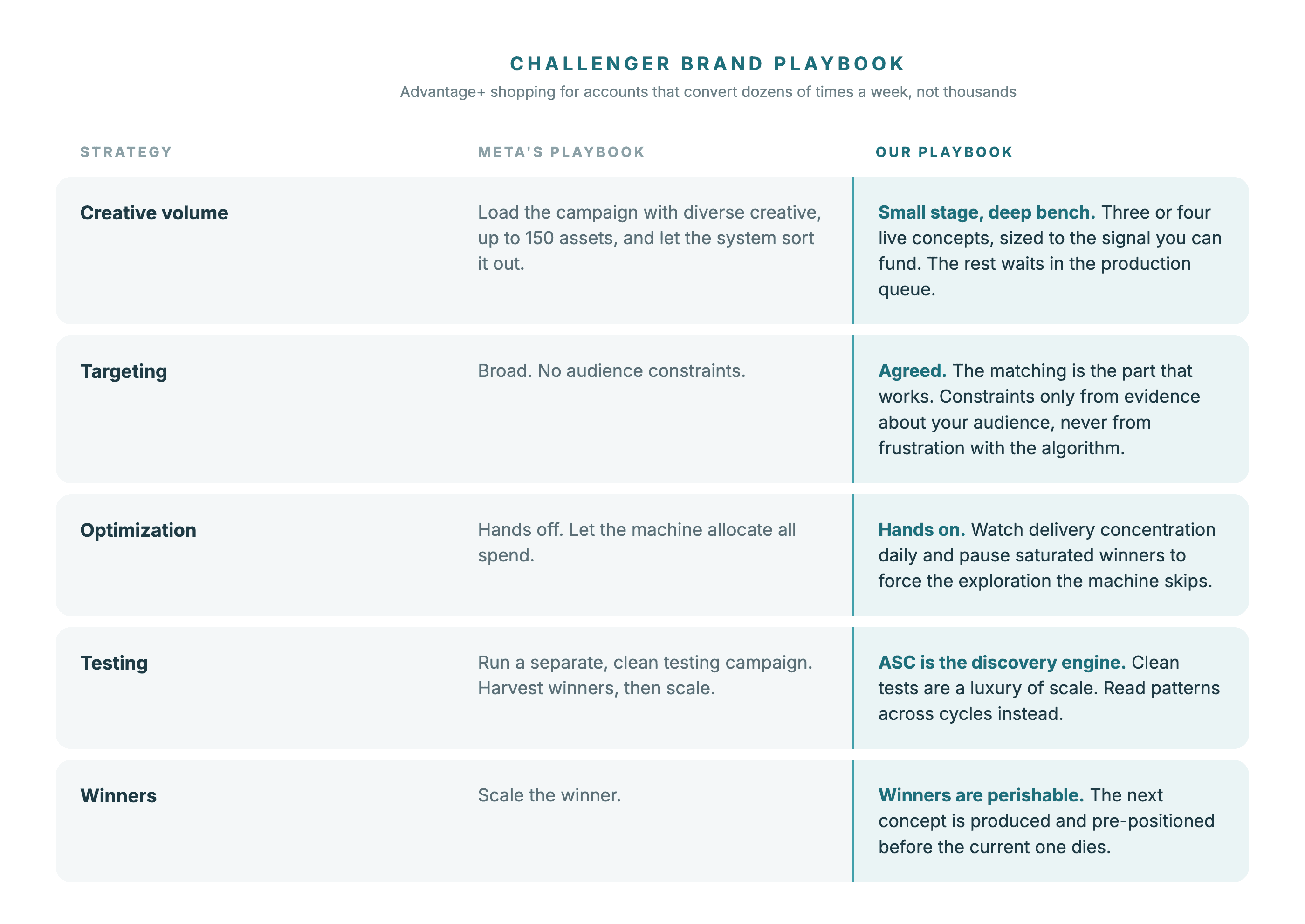
Size the slate to the signal
Which leads to the conclusion Meta’s own guidance argues against: run less creative in ASC, not more. The platform says to load the campaign with diverse assets and let the system sort it out. But if the machine only ever seriously serves one or two ads, uploading twelve does not give you a twelve-ad portfolio. It gives you a two-ad portfolio and ten concepts that never get read.
The logic is simple once you accept that the creative is the targeting. Every concept in the ad set is really an audience hypothesis, and a challenger account converting a few dozen times a week has enough signal to fund honest reads on maybe three or four hypotheses at a time. So that is what the campaign should hold: the reigning winner, a challenger or two, and one fresh concept, with the rest of the portfolio waiting in the production queue instead of dying unread in the campaign. Small stage, deep bench.
It scales as a ladder. At challenger spend, it is one ASC with a small stage and deliberate rotation, because splitting thin signal across two campaigns just recreates the disease. As spend grows past what one campaign’s rotation can absorb, graduate to a feeder structure: small batches prove out in a low-budget ASC, and winners roll into the master. Same principle at every rung. Your creative slate should be sized to the signal you can actually afford, not to the upload limit.
We are rolling this discipline across our accounts now, and I will publish the numbers.
What you keep
You do give up clean learnings running this way. But you do not give up all learning. Run enough cycles and patterns emerge across the winners: which persona keeps producing them, which hooks keep getting crowned. It is dirtier signal than a proper test, but it is signal you can actually afford, and it feeds directly into what to produce next.
The honest summary: Meta will find your customer from the creative alone, faster than anything else in advertising. It will also mismanage your creative portfolio while it does it. The machine is a great matchmaker and a terrible portfolio manager. Once you accept both halves of that sentence, the job description gets clear. Let it find your customer. Do not let it run your creative. That part is still yours.